You can write great content, get decent traffic, and still see affiliate sales that feel random.
One week you get a few commissions, the next week nothing, and you can’t tell what you did differently.
Most of the time, the issue isn’t the offer.
It’s the timing.
You’re showing the right product to the wrong reader mood.
This post gives you a simple affiliate marketing worksheet you can finish in about 60 minutes.
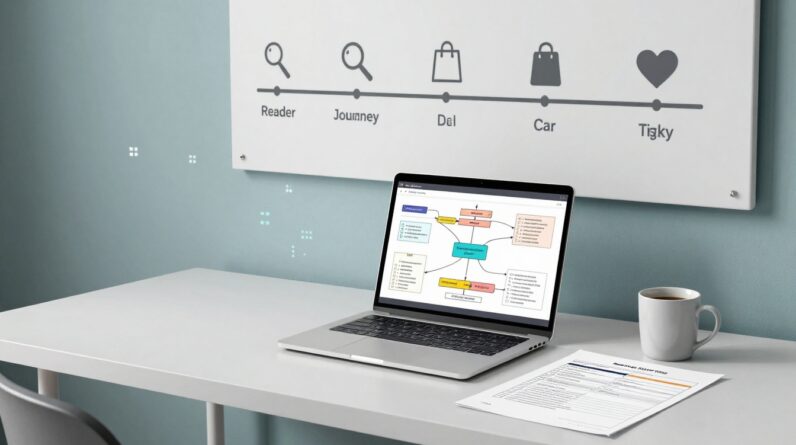
You’ll map your affiliate offers to the reader journey, so your recommendations show up when they make sense.
What this 60-minute worksheet changes in your affiliate marketing

Think of your content like a guided store.
If someone just walked in, you don’t shove the checkout screen in their face.
You help them find the right aisle first.
This worksheet helps you do three things, fast:
- Stop guessing which links to add to which pages.
- Match intent (what the reader wants right now) to the right type of offer.
- Build a repeatable system you can use for every niche, product, or campaign.
The good news is you don’t need fancy software.
One page and a timer is enough.
The three reader journey stages that matter (and what readers want)
You’re mapping offers to what your reader is thinking, not to what you want to sell.
Awareness (they feel the problem)
At this stage, your reader is trying to name what’s wrong.
They want clarity, not options.
What works here:
- Simple definitions, checklists, “why this happens” posts
- Free tools, low-friction trials, intro products
- Lead magnets (if you use email)
What usually fails here: high-ticket offers, long demos, “best X software” roundups with heavy buying language.
Consideration (they’re comparing paths)
Now they’re choosing between approaches.
They’re open to tools, templates, and methods.
What works here:
- Side-by-side comparisons (with honest tradeoffs)
- Tutorials, setup guides, case-style examples
- Mid-priced tools that remove a clear pain point
Decision (they’re ready to pick)
This reader wants proof and a safe next step.
They’re asking, “Will this work for me?”
What works here:
- Reviews, “how it went,” pricing breakdowns
- Bonus stacks (your own checklist, onboarding email, mini-course)
- Offers with clear onboarding and support
Your 60-minute affiliate marketing worksheet (one page)
Grab a sheet of paper or open a blank doc.
Draw three columns labeled:
- Awareness
- Consideration
- Decision
Now add three rows:
- Reader question (what they’re asking)
- Content types (what you’ll publish)
- Affiliate offers (what you’ll recommend)
That’s the whole worksheet.
The value comes from filling it with real answers, not perfect ones.
A helpful rule while you fill it in: one main offer per stage.
You can add backups later, once the map works.
The 60-minute timer plan (so you actually finish)
Set a timer and move fast. If you get stuck, write the best guess and keep going.
You can revise later.
Minute 0 to 10: Pick one clear reader outcome
Write one sentence:
“My reader wants to _______ without _______.”
Examples:
- “start email marketing without sounding salesy”
- “lose weight without counting every calorie”
- “get freelance clients without cold calls”
This outcome becomes the center of your map.
Minute 10 to 25: List the real questions people ask
Fill the “Reader question” row across all three stages.
Prompts that work:
- Awareness: “What is this?” “Why is this happening?”
- Consideration: “Which option is better?” “What does it cost in time or money?”
- Decision: “Is it worth it?” “How do I set it up today?”
Use language you’ve seen in comments, Reddit threads, YouTube questions, or client calls.
Minute 25 to 40: Match content types to each stage
Now fill the “Content types” row.
Keep it simple.
Examples:
- Awareness: beginner guide, glossary post, myths post
- Consideration: comparison, tutorial, workflow post
- Decision: review, setup walkthrough, “best for X” post
If you run email, add one email per stage too.
One is enough to start.
Minute 40 to 60: Assign affiliate offers by stage
Fill the “Affiliate offers” row last.
This reduces the temptation to force a product into every post.
Aim for:
- Awareness: low-risk entry (free trial, under $50, or a tool people can test fast)
- Consideration: the “default choice” product you’d recommend to most readers
- Decision: the best-fit offer with strong proof (or a higher-priced option)
Write the offer name plus a one-line reason it fits that stage.
How to choose offers that fit the journey (without hurting trust)
The fastest way to lose clicks is pushing offers that don’t match the moment.
Use these filters:
Problem match: Does this product fix the exact problem the content is about, or is it a loose connection? Loose connections don’t convert.
Friction level: How hard is it to start? Logins, learning curves, and long setup steps belong later in the journey.
Proof you can show: Can you demonstrate the result, the workflow, or the outcome?
Screenshots, steps, and honest pros and cons help a lot.
Payout is last: Commission size matters, but it’s not your first filter.
A smaller payout that converts beats a bigger payout that never closes.
If you can’t explain why the offer fits in one sentence, it’s probably not the right match.
Turn your worksheet into content that earns (without spamming links)
Once you have the map, you’re no longer “adding affiliate links.”
You’re placing the right next step.
Here’s how that looks in real content:
In Awareness posts: Mention the tool lightly, like a helpful option, then focus on teaching.
Add one link, once.
In Consideration posts: Show your process.
Explain what you tried, what you chose, and who each option is for.
In Decision posts: Make the next step obvious.
Add a short “Start here” section, include setup steps, and answer objections (refunds, time, learning curve).
If you have email, your worksheet also becomes a simple 3-email sequence: one helpful lesson per stage, then a decision email with your best recommendation.
A quick example map (so you can copy the pattern)
Let’s say your niche is “start a side hustle with print on demand.”
- Awareness
- Reader question: “What is print on demand, and can I do it?”
- Content type: beginner guide, “cost to start” post
- Offer: a beginner-friendly course or tool with a free plan (low-risk)
- Consideration
- Reader question: “Which platform should I use, and what sells?”
- Content type: platform comparison, niche research tutorial
- Offer: the platform you’d pick for most beginners, plus one research tool
- Decision
- Reader question: “How do I launch my first product today?”
- Content type: step-by-step setup, product listing template
- Offer: the platform again (now with onboarding steps), plus a paid template pack
Same niche, different moment. The offer stays similar, the angle changes.
Your next step with this affiliate marketing worksheet
If affiliate income feels streaky, don’t write more content yet.
Take 60 minutes and map your reader journey on one page.
You’ll see gaps right away, especially where you’re pushing decision-stage offers to awareness-stage readers.
Pick one outcome, fill the worksheet, then publish one piece of content per stage.
Keep it tight, keep it honest, and let intent do the heavy lifting.
What would happen to your commissions if every recommendation showed up at the right time?